Your trusted financial advisor
"If you cannot find it, then design it."
Throughout more than 40 years in financial services, one belief has guided everything: there is always a smarter solution. On this page you'll find fresh, practical approaches to insurance, savings, health cover, and wealth that work in your life — on your terms.
You can choose the first-year reward or stay in for five and ten years. The longer you stay, the greater the reward will be.
We must tweak our thinking & accept the truth
This is the area of easiest attack for reducing your insurance cost — when purposefully implemented. Insurers are required to balance their expenditures with income, which means cashback rewards and other benefits are simply built into your premium. You pay for it.
Yes, you can. Read on.
We start by tweaking thinking with real insights and saving you between 20% and 30% on monthly premiums. You are advised to accumulate these savings as we progress to the next level.
Personal reserves grow year on year. Unlike insurers, we can reserve in our personal capacity throughout the program — something SARS does not incentivise insurers to do.
When you reach fulfilment of the plan after 10 years, you may well be in a position where a drawdown from your accumulated reserves pays for the reduced balance of premium — effectively reducing your cost to nil.
There is no greater way to protect your wealth than comprehensive life cover. Dread disease, income protection, and life insurance work together to keep you and your family secure through any event.
The hidden risk: Cover increases at CPI (±6% per year), but premiums must increase at ±10% to cover insurer costs. Over time, premiums double every 7 years while your cover only doubles every 12 years.
If you're still in good health, you can switch to a lower premium somewhere between the 7th and 12th year. Once you become uninsurable, that window closes.
My friend John was diagnosed with Non-Hodgkin lymphoma. His dread disease cover responded immediately with cash for procedural costs. His income protector paid his salary each month while he couldn't work. When he later passed, his life insurance cleared all his debts and left a portion for his partner.
John had comprehensive cover. Most portfolios lack income protection entirely — the single most critical gap we see.
— A real story from a client's lifeEvery spend model recommends that 20% of income go into savings. In South Africa, the average is less than 5%. Through our various programmes, we find ways to help you bridge that gap.
I personally tested three investments with the same major insurer and found returns ranging from 3% down to -1% — clients were putting in more than they were getting back.
Investments are no longer restricted to insurers and banks. Property, tax-free savings, and diversified portfolios all have a role. Everything in life should be kept in balance.
Medical aid has become the most impactful expense in your budget — and it is growing unchecked. What started at roughly 10% of income now often exceeds 30%. Without serious intervention, a 30-year-old today will require 250% of their then-income just to pay for medical aid in retirement.
The past advice of "buy the best you can afford" is costly and unnecessary. What you need instead:
Upgrade or downgrade each year based on actual utilisation. Most people can downgrade and pay less.
Use some of your savings to buy GAP cover and bank the rest to fund future increases as they occur.
New opportunities combine medical aid with health insurance elements into a blended, less expensive solution — often at higher service and benefit levels. Adviser cost is already included in the premium.
Your plan must provide sufficiently for family needs now, after death, and after retirement. The level of adequacy is defined by capital preservation at a 5% drawdown — meaning you need to provide 20 times the income required at each life event.
When the total value of your assets and cover exceeds R3.5 million, estate planning becomes essential to cater for estate duties, taxes, and capital gains.
At a 5% annual drawdown, you need assets equal to 20× the annual income you require. Plan for this at every stage: now, after death, and at retirement.
Once your combined asset value (including cover) exceeds this figure, you need additional provisions for duties, taxes, and capital gains tax. Incorporate investment plans to complete interim and long-term savings targets.
Once plans are established, writing a will and establishing trusts becomes critical — to dispense assets and investments precisely according to your wishes. Do not delay this step.
Every large corporation is required to keep a budget. Yet only 1 in 20 private citizens do. That same 5% are consistently the most successful and wealthiest in every community — the ones who can afford to retire one day.
The challenge: without control, a single need can consume your entire 50% needs allocation, and savings suffer first. Once savings disappear, debt follows.
Each of life's five important areas is awarded 20% of your budget. These percentages flex to fit your style, stage of life, and age — but always add up to 100%.
Home loan, levies, rates, insurance, maintenance — capped at 20%.
Car repayment, insurance, fuel, maintenance — your full mobility cost at 20%.
Food, groceries, utilities, and all running costs — 20%.
Education, health, clothing, recreation, and family commitments — 20%.
The non-negotiable 20% that creates wealth — never sacrificed for the other four.
Without budget control, home and car alone consume 55% or more of income once insurance, levies, fuel, and maintenance are included — leaving nothing for savings. We rebalance this to 20% each.
My Fair Share programmes supply templates and webinar or video guidance on how to correct your budget, get out of debt, and build wealth — all from the same budget from which it currently appears impossible.
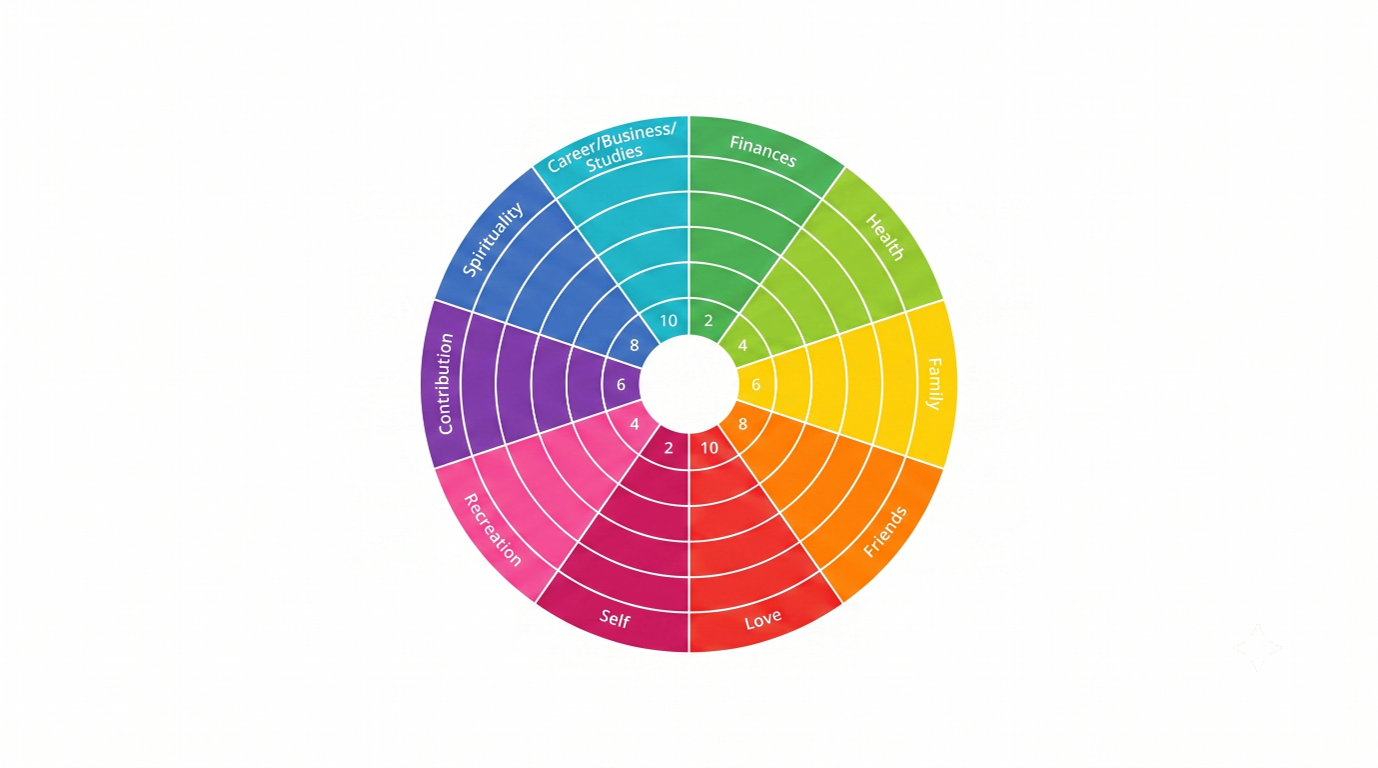
Life is more than just money. Here we pursue a journey to balance all sectors of life with finances, drawing on the wisdom of Solomon — widely acknowledged as the wisest person who ever lived.
These principles create longevity of life, better relationships, stronger bodies, healthy minds, generosity, and much more.
A balanced life wheel covers Career, Finances, Health, Family, Friends, Love, Self, Recreation, Contribution, and Spirituality — each area deserving intentional attention.
Fill in the form and one of our advisors will be in touch to discuss a solution tailored specifically for your situation.
Whether it's a single product enquiry or a full financial life plan, we're here to assist you every step of the way.
Your information is kept strictly confidential and will only be used to contact you regarding your enquiry.